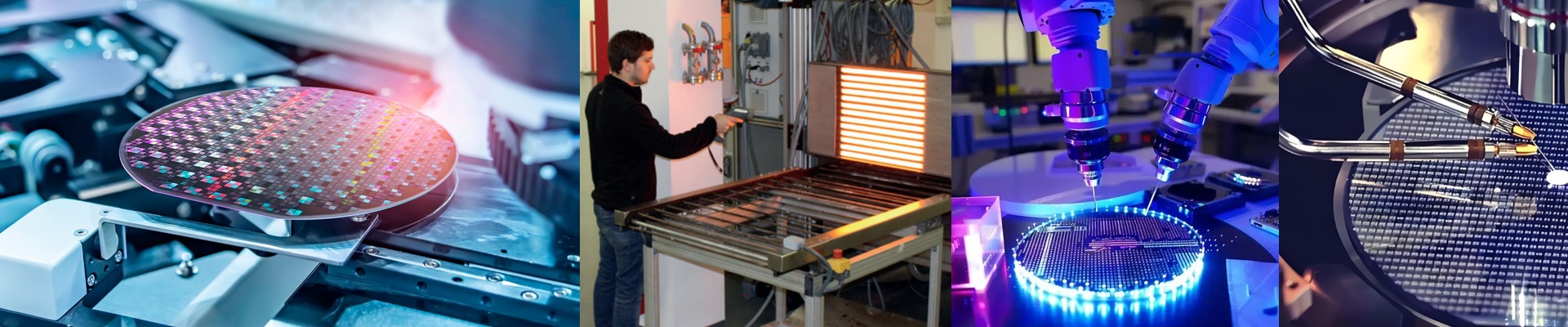
On the line, display driver IC wafers don’t forgive thermal drift. Soft bake that’s even 0.5°C off profile, and photoresist thickness starts to wander. Exposure latitude evaporates. In the drying bay, moisture that isn’t fully pulled out sets you up for micro-bridging. You don’t see it until yield drops weeks later. We built our infrared heater for these exact headaches—tight thermal budget, no room for drift, repeatability as the baseline. What matters, technically We run short-wave infrared with fast-response quartz emitters. Across 200 mm and 300 mm wafers, you get wafer-level uniformity within ±0.1°C. Bake-to-bake temperature repeatability holds at ±0.2°C, so soft bake, hard bake, and photoresist curing stay on target without chasing the setpoint. It lives in Class 1–100 cleanrooms with zero particle generation, confirmed by in-line particle monitoring. Energy draw is tuned per recipe, and thermal ramp profiles repeat within 10 ms. That protects thin-film stacks from thermal stress. Why it sticks in display driver IC processing The stack is sensitive: low-k dielectrics, thin metals, fine pitch. Thermal control has to be disciplined. With our infrared profile, photoresist performance locks in. Rework drops, and changeover tightens because you cut out the long warm-up drift. Wafer drying finishes with consistent dehydration, which lowers defect density and stabilizes lithography overlay. The payoff is tighter critical dimension control, fewer defocus events, and a process window that behaves predictably shift after shift. Things to know before you roll it in The heater drops into existing tracks and bake plates, but alignment is strict. Emitter-to-wafer distance has to stay within ±0.5 mm to keep uniformity. Recipe transfer means matching the thermal mass of your carrier and the emissivity of the wafer backside. Plan a short qualification run to nail ramp rates and soak times. Once set, it runs 24/7 with minimal maintenance, and the lamps are rated for 5,000+ hours at stable output.